re: What Sun should do
FYI: I'm tracking blogs and other reactions to Tim Bray's What Sun should do blog post on delicious.com at the link below. Judging from the reaction so far, I think Tim should have opened up comments on this one. He would have gotten more, and possibly better feedback.
New era for JSPWiki

Janne Jalkanen: We are now beginning a whole new era with becoming an Apache project and JSPWiki v3, which will signal the first major overhaul of the entire software since v2.0 in 2002. We've got a bunch of good committers (with a new one added this weekend - welcome, Florian!) and a bunch of pretty exciting things we want to do.
I'm so happy to see JSPWiki thrive at Apache, even in the incubator. You may remember that I wrote to Janne back in Summer 2007 and suggested the move, and I've crowed about it before, but Craig Russell is the one who stepped up to mentor the project and, from what I've seen, he's doing a great job.
Sun should give up on the desktop?
Tim Bray: What Sun should do: Sun is going through a lousy spell right now. Well, so is the worldâs economy in general and the IT business in particular, but this is about Sun. This is my opinion about what my employer should do about it.
It takes a lot of guts to write a piece like that and I'm really glad Tim did it. I'm going to walk out on the same limb and agree with pretty much everything Tim wrote. Tim wants Sun to focus like a laser on providing the best web platform around with Solaris, storage offerings, Java/Hotspot, Glassfish, MySQL and Netbeans for Java, Ruby, PHP, Groovy, etc. tooling. He writes:
Itâs easy to understand how our servers, CMT and x86, and the Solaris OS, fit into the Web Suite. All the software, including the HotSpot, GlassFish, and MySQL runtimes, needs to be obsessively tuned and optimized to run best in the context of the Suite. Obviously, the Suite will also include Ruby and Python and PHP runtimes, similarly tuned.
All of Sunâs software tooling should have a laser focus on usability, performance, and ease of adoption for the Web Suite.
I agree, but as a web geek I guess I'm pretty biased.
Tim doesn't shy away from the critical question of what Sun should stop doing. Tim says Sun should give up on the client-side, dropping JavaFX and JavaME (and OpenOffice too, I presume). Here's Tim on JavaFX:
For actual business apps, the kind that our servers spend most of their time running, the war for the desktop is over and the Web Browser won. I just totally donât believe that any combination of Flash and Silverlight and JavaFX is going to win it back.
I can't say I disagree with that either. Cutting JavaFX and JavaME would be extremely tough and painful decisions, but somebody's going to make to make some of those. Looking at things from Tim's web-platform-only point of view, they make sense. Sun needs only enough client-side software to keep Solaris attractive to developers and to support great development tools on all the platforms that web developers love.
ICBMs of friendship
No, that's not the start of a nuclear war. It's something much more friendly: a visualization of Facebook friend requests zooming around the globe. It's part of a three minute video produced by Palantir, a Java-powered Facebook Hackathon project that "visualizes all the data Facebook receives."
<img src="http://rollerweblogger.org/roller/resource/friendrequets.png" title="screenshot of Facebook visualization video" alt="visualization" />At the start of the video, the narrator mentions that they're using the JME framework. That's the open source jMonkey Framework, a "high performance scene graph based graphics API."
Via TechCrunch.
Technologies of Friendship
I'm honored, excited and now I'm prepared.
I just finished writing up some notes for tonight when I'll be one of four guest speakers talking to Fred Stutzman's Technologies of Friendship class at UNC. Here's Fred's reminder post:
Atom news: Apache Abdera graduates

Congratulations to the Apache Abdera team, who've just graduated to full Apache top level project status. The don't have the new site at abdera.apache.org up yet and they're still not quite at 1.0 yet, but this is a major milestone. They've got the best Atom format and protocol toolkit around, in my opinion.
SocialSite's Flexible Relationship model
CommunityOne call for papers is open X 2
Next year there will be two CommunityOne events in the US of A; one in New York City on March 18 and the other, coinciding with JavaOne week in June 1 in San Francisco. Here's the call for papers link. The call closes on December 11.

Details of Roller setup at blogs.sun.com
Meena Vyas, Murthy Chintalapati and Allen Gilliland just published an article on BigAdmin that describes the architecture of blogs.sun.com, a Roller, Sun Web Server, Memcached and MySQL based site that averages 4 million hits a day with its two SunFire T2000 servers at 97% idle. You can get the article for free (registration required) here: Sun Blogs: A Sun Java System Web Server 7.0 Reference Deployment
<img src="http://rollerweblogger.org/roller/resource/bsc-architecture.png" title="blogs.sun.com architecture" alt="diagram" />Worth checking out: reglib vs jQuery
I've been doing a lot of JavaScript work lately for Project SocialSite and, to my surprise, enjoying it greatly. I've also been making use of JQuery, so Greg Reimer's post on reglib vs. JQuery really caught my eye.
Here's the opening blurb from the reglib project site:
CSS is nice because it lets you declare styles without worrying about DOM load, traversal or having to reattach styles as the DOM gets updated over the lifetime of the page. Which raises the question, why isn't the behavior layer similarly declarative?
/* the style sheet */
div.menu li > a { color: blue; }

/* why not a behavior sheet? */
div.menu li > a { click: function(e) { ... }; }
reglib's goal is to get as close to that as possible:
reg.click("div.menu li > a", function(e) { ... });reglib is so named because it lets you "register" an event handler against a CSS selector. Like CSS, once the above code is "declared", the event handling behavior takes effect globally. This is true regardless of whether the onload event has fired, or whether the DOM has finished loading off the network, or whether arbitrary sections of DOM have been overwritten.
Cool stuff, huh? Check out the DEMO page Greg has put together "rigged like a science experiment" to demonstrate the differences between JQuery and reglib.
Carolina blue
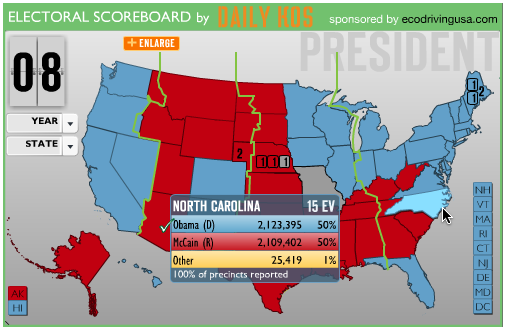
My country and even my state have made me damn proud this week. Congratulations to President-elect Obama and thanks to all the folks who worked so hard for change over the past couple of years.