Dev tool double-talk
"The IDE from BEA is very difficult. It isn't the traditional IDE that most Java developers are used to working in, with an editor, compiler, debugger-type of tool," Murphy said. WebLogic Workshop is oriented toward Visual Basic programmers, while TogetherSoft offers a traditional J2EE development, he said. [ InfoWorld, BEA, TogetherSoft partner...]
Wait a minute here, the IDE from BEA is both "very difficult" and "oriented toward Visual Basic programmers?" That sounds like a bit of a problem, doesn't it? I'm sure adding some UML tools is the key to dumbing it down to VB level... not! I do hope TogetherSoft can straighten those BEA guys out.
Perforce and Eclipse
Turns out, there is a Perforce plugin for Eclipse! It is called P4Eclipse. I just installed it and it looks awesome, even though it is only a v0.0.8 release.
Built-in Blog
Steven Vore points out that TopStyle is one of the first products he's seen that has a weblog built into it. Here's the Weblog . Update: here's a picture of how it looks inside TopStyle [ Raible Designs, Built-in Blog] .
When I read Matt's post earlier today, I assumed that TopStyle is an HTML editor that now has weblog publishing features. On closer inspection, it appears that is not the case?
Anyway, this made me start thinking about weblogging software as a commodity. If it is a commodity that means you can't really make money selling weblogging software. You might be able to make money selling weblogging related services as weblogger.com does, or you might be able to make your existing software more valuable by adding weblogging features to it. Seems to me that weblogging features would make sense in an HTML editor/publisher, portal software, or even an e-Commerce suite. I wonder what other categories of software would benefit from weblogging features.
UPDATE: Russell commented on this post.
More on Skribe
Reading more on Skribe in the Noumenauts Yahoo Group, I found an interesting email exhange about revenue schemes. Apparently, one idea is to build blogging software that allows bloggers to establish different categories of blog posts and then charge money to readers who wish to read premium categories. Then Noumenauts takes a cut of that money. Apparently, they hope to appeal to celebrities (they mention luring Wil Wheaton away from Movable Type as an example) who want to make money off of blogging.
Hey Russell, this might be the ticket! Pull an all-nighter, add premium categories to MiniBlog, and fund your trip to Esther Dyson's big-blowout in Berlin. "Want to know how I feel about lawyers? Just enter your credit card number and hit the submit button."
Skribe
This " competitors" document keeps on showing up in my referrers logs and finally piqued my interest enought to get me googling. Apparently Anna and friends are working on Skribe , an "Open Source, Java-based, robust, flexible, dynamic web journaling application" developed using a modified RUP process. Hey guys, why re-invent the wheel? You all ought to sign up as developers on the Roller project. You are looking for an architect, right? I'll be happy to tell you what to do ;-)
Pingback vs. Trackback
I don't like having comments on my Web log because I believe if you want to comment then you should do so on your own Web log. If I'd wanted to host a discussion forum, I'd have installed discussion forum software, not Web logging software! [ Hixie's Natural Log, Whitepaper: Pingback vs. Trackback found via diveintomark]
I still think comments are a nice feature, if only for those hapless folks who have no weblog.
Roller 0.9.6 soon come
From the looks of Roller's JIRA roadmap, it looks like Roller 0.9.6 is not very far off, perhaps next weekend?
Perl v. Java... NOT
Anthony Eden's FreeRoller site had some Roller problems today and CWinters caught it as a screenshot. Man, I hate that! I noticed it too. I'm hoping that this was caused by a simple DBCP database connection pooling configuration problem. The Roller Installation Guide suggests a DBCP maxWait of 100 milliseconds which is way too low. The maxWait should probably be set to 20000 or 30000 milliseconds on a big site like Anthony's.
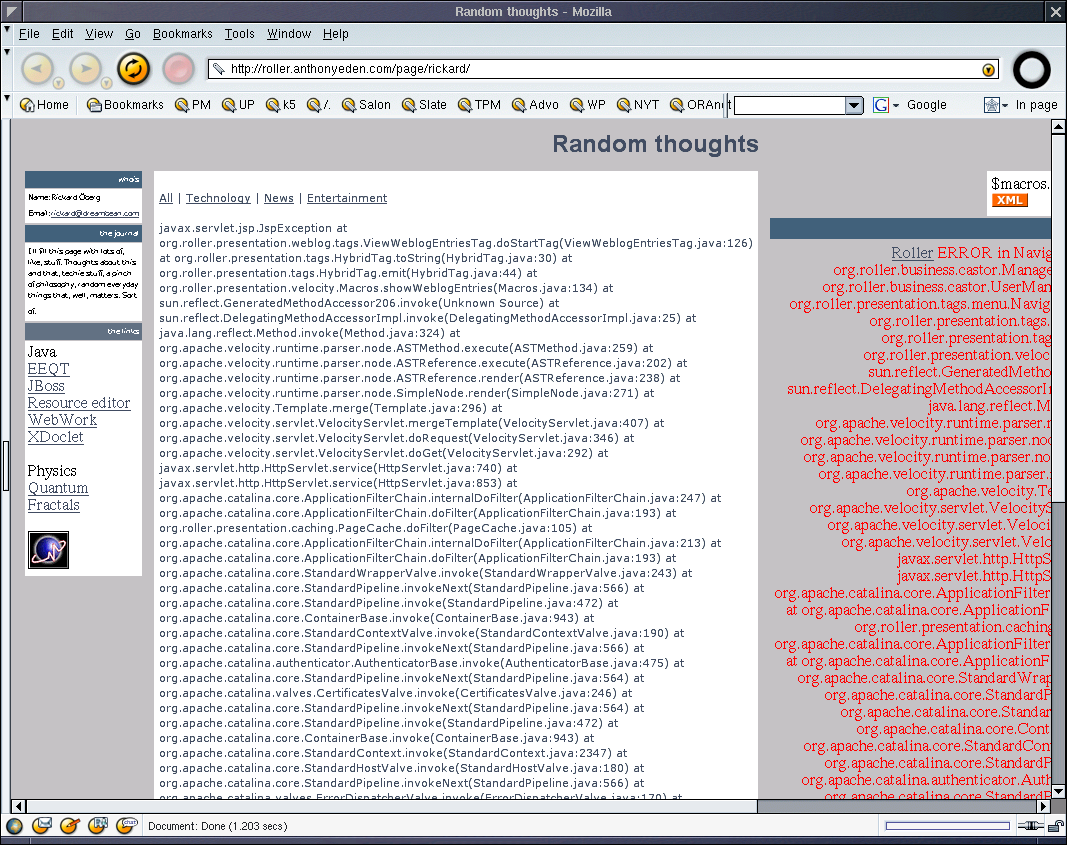
The problem may have been amplified by the Roller page caching mechanism. You see, Roller uses OSCache to cache weblog pages. If an error occurs, a page full of error messages might find it's way into the cache and not get cleared out until either the weblog's author makes a change or the cache entry times out. Maybe Roller should invalidate the cache when an error occurs? Hmmm...
Thanks Greg!
As cool as it gets, Eclipse (partially) has this really nifty feature! It's called "label decorations" and is a generic way to add custom information to labels associated with project resources. It has to be enabled in the preferences:
Window->Preferences->Workbench->Label Decorations->CVS
What's more, you can also heavily configure the format of CVS label decorations in:
Window->Preferences->Team->CVS->Label Decorations
You can see what's the status of your CVS controlled resources in the project tree. I'm not quite sure if you can see clearly who's doing what with files. [ Greg Klebus, Java To Go]
Thanks Greg, that is exactly what I wanted. Clearly, I need to spend a little more time RTFM'ing before I shoot off my mouth. And Greg, I've been meaning to tell you that your English is just fine - I would not have noticed that you were not a native speaker if you had not mentioned it.
Hey Perforce, are you reading too? If so, get to work on Eclipse integration. I'd like Eclipse to be as easy to use at work (where we use Perforce) as at home (where I use CVS for Roller). UPDATE: Turns out, there is a Perforce plugin for Eclipse, it is called P4Eclipse.
Eclipse and CVS usability
I'm still working with Eclipse and enjoying it. I do find that it gets sluggish at times, usually after I leave it alone for a while, but once it warms back up it is nice and snappy. Still, I have not totally weaned myself from VIM and I am not sure I ever will.
One thing that I find irritating with Eclipse is that it is difficult to figure out what files I have modified in my local work space. Sure, I can do a Syncronize With Repository and get a tree view that shows what files I have modified, but that is rather slow and cumbersome even for a fairly small CVS project like Roller. With WinCVS, I can easily see the files that have been modified as they show up with bright red icons. The WinCVS Flat-Mode is especially useful for this. It would be nice if the Eclipse Resource Perspective could use different icons for files that have been set writable, files have been locally modified, and files that are untouched.
My favorite source code management system Perforce uses change lists. When you check files out you must check them out into change lists. You can use these change lists to organize your work. I might have one change list for "Ekit editor integration" and one for "Admin UI security fixes." It is really easy to see what files you are working on in each change list and what change lists and files your coworkers are working on.
I know that CVS does not support change-lists, but it would be cool if Eclipse would make it easier to see what files you have modified in your local work space and what files your coworkers are editing.
More on JSF and Struts
Craig McClanahan has written up his thoughts on Struts and JSF integration. There is also a thread about this on Floyd's blog.
Macros to support RSS templating
If we had the right macros, or at least the ability to specify which day template to be used in the macros.showWeblogEntries() macros, we could easily build an RSS 2.0 template based on Mark Pilgrim's RSS 2.0 template for Movable type. This is Roller issue <a href= "http://opensource.atlassian.com/projects/roller/ViewIssue.jspa?id=10090"> ROL-50.
Roller needs better RSS aggregation?
Initially I was using Roller's newsfeed aggregator to monitor what was going on in the blogs which I find interesting. Now I am finding more and more that I am going to a few blogs all of the time and then jumping to other blogs from their blog lists. I think this is partially because the Roller aggregator is not very good (all real-time, pain to add new feeds, etc.) [ Anthony Eden, Interesting...]
So true. I'm surprised you were able to endure the pain for so long. I would like to add better aggregation features to Roller and have been toying with the idea of adding a full featured aggregator. I'm not sure a full-featured aggregator belongs in Roller, maybe Rickard is right in saying that aggregation is a client side job. Here are the reasons that I think a server-side aggregator should be integrated into Roller:
- Many users will subscribe to the same news sources and so can share a cache of the newsfeed data.
- Having an integrated aggregator will allow us to add a "Post about this item" button to each news item thus making it easier to comment on the posts of others.
- Roller already allows you to display newsfeeds, via the macros.showNewsfeed() directive, on your blog and having the newsfeed data cached will make these directives perform a lot better
Here are a couple of reasons against including an aggregator in Roller:
- Will not scale. Running a multi-threaded scheduling engine in process with a Servlet Engine, Roller, etc, will be a big burly memory eating bear. And what if you want to distribute Roller accross multiple worker processes?
- Web UI is clumsy. Wouldn't you rather have a pretty little JFC, SWT, Thinlet, or dot-Net app running on your PC as your aggregator?
- Others disadvantages that I can't think of because I am biased towards the server-side?
FreeRoller
Anthony Eden, who has been generously offering free Roller accounts for a couple of months now, has just renamed his Roller site FreeRoller. What a cool name! This gives me another opportunity thank Anthony for doing what he is doing. Not only is he making possible a bunch of cool weblogs, but he and his bloggers are giving us some great feedback on Roller. Not everbody is totally happy with Roller and that is fine, but I'd like them to be specific about the things that suck (I can take it ;-) and even file some bugs if they have the time. Thanks again Anthony.
Rickard's comments on the shootout and the war
Rickard Öberg has posted some great comments on the J2EE Container Shootout. Before you get to the J2EE Container Shootout comments, keep an open mind as you read Rickard's comments on Bush's "war on terror" - like it or not, this is how we Americans look to some of our best allies.
Comments on the J2EE shootout
Andy Oliver, who was instrumental in putting together the TriJUG's J2EE Container Shootout, adds some comments to the shootout post on the Java Lobby.
J2EE Container Shootout Summary
I attended the Triangle JUG's J2EE Container Shootout last night and it was a lot of fun due in great part to the flamboyant verve of Marc "you can walk through walls, just like us" Fleury of JBoss fame. Also behind the panelist table were: Robert Patrick of BEA, Greg Ackerman of IBM, and Farzin Barazandeh of Oracle. There were twelve questions and each panelist was given from 2-4 minutes to answer each. Then there were free form questions from the audience. I will try to summarize from my notes what I considered to be the most interesting question and answers for you:
What applications justify the use of EJB?BEA: Robert says that even for small apps, you should design with future migration to EJB in mind. Use EJB if your developers have the skillset for EJB.
ORACLE: agrees that skillset is important. If you are a database house, you might not want to go the EJB route. EJB is not yet truly mature and does not do all the things that a great database can do.
JBOSS: Marc says: don't access the database directly from Servlets and JSP, use EJB intead. EJB caches data for web applications very well and can be ten times faster than ordinary database access. But Marc doesn't stop there. He goes on to say that some companies allow licensing costs to drive their architecture choices and stay away from EJB because of cost, with JBoss you don't have to worry about licensing costs. From the way the BEA panelist rolls his eyes, I get the feeling that he has come up against Marc before.
IBM: Greg also agrees that skillset is important and agrees with the other vendor's points. He also adds that EJB 2.0 brings some real developer productivity increases to the table. Greg recommends using IBMs "redbooks" and J2EE best-practices to determine your architecture.
What is the biggest threat from dot-Net and what are you doing about it?
BEA: Robert says that it is a sure bet that dot-Net will be "ready for prime time" in the near future. Currently, dot-Net only makes sense for small systems. To combat the threat Sun needs to work closely with the ISVs, improve development tools, and must have interoperability with dot-Net via web services.
ORACLE: Farzin answers that the biggest threat from dot-Net is the fact that it is from Microsoft and therefore will automatically gain acceptance. Java can't let it's community driven nature slow it down and at the same time needs to stick to the standards to ensure interop, portability, etc.
JBOSS: Marc proclaims that he is a "closet Microsoft lover" and that he takes Microsoft very seriously. But, he contends that Java has nothing to fear from Microsoft. Java is portable and the runtime is free. The difference between JBoss and Microsoft is philosophy. Microsoft wants to commoditize the $20/hour developer and JBoss wants to commoditize the runtime and the application server. As far as the standards are concerned, Mark says that Sun does move slow. Use JBoss and the standards will follow.
IBM: Greg says that IBM vs. Microsoft is not the story. Dot-Net is vapor now but Microsoft will eventually get it right. He says that to fight against Microsoft, Java needs to be more of a standard. Sun can't keep veto power and expect Java to keep up.
Do you support JDO and what are your plans for JDO?
JBOSS: we have been supporting JDO for quite a while via Castor and other means. But, JDO has not taken the persistence crown. EJB/CMP is much more powerful than JDO. JBoss is working to decouple the CMP engine from JBoss so that it can be used independently of EJB.
ORACLE: The Oracle app server does not supprt JDO, but our new TopLink product is very close, and may enable Oracle to support JDO in the future.
BEA: does not support JDO and says that JDO is not compelling vs. CMP 2.0.
IBM: Websphere 4 and 5 do not support JDO. IBM is still trying to figure out what to do about JDO.
Which of your competitors products would you choose?
ORACLE: Farzin tried to answer Orion, but Oracle's app server is an OEM version of Orion, so that did not fly. Then Farzin said that Websphere is too big, Weblogic looks OK, but since JBoss is free and easy to use he would choose it.
BEA: Robert said that JBoss is free and for development purposes would get the job done, but for mission critical apps he would choose WebSphere - but only if he could affort the IBM consultants required to set it up. He said that "WebSphere can be made to work," the dev tools are good, and the admin console is nice.
IBM: Greg said that he might download Oracle's app server, but he would be worried that Oracle would change code-bases before the download was complete. For mission critical apps, he would choose WebLogic because there are so many developers that are familiar with it.
JBOSS: Marc said that he would choose Oracle because Oracle is Orion and Orion was developed by Rickard Oberg's room-mate and therefore Orion is very similar to JBoss. His second choice would be WebSphere because IBM will be around for ever and ever - it is always a safe choice.
What do you see happening with J2EE and development in 5-10 years?
JBOSS: Marc says that J2EE is at the end of its road. Now developers need to learn to be container developers, to take apart the containers, and to pick and choose which parts they want to use in their apps. Then developers will be able to walk through walls like the JBoss folks do. Also, the dot-Net ability to hang attributes on methods and fields of classes will be come very important and combined with interceptors will enable aspect oriented programming, grid computing, blah, blah, blah. I'm not kidding, Marc really likes to say "blah, blah, blah."
BEA: Robert says it is very difficult to predict the future, but that he sees that XDoclet-like method and field attribute driven development will be important and that web services will be very important.
IBM: I can't remember what Greg said, but I am pretty sure he mentioned web services and grid computing. Oh yeah, he started off by saying that J2EE is not at the end of the road - it has a long, long way to go.
ORACLE : I can't remember what the Oracle guy said at all. Sorry folks.
Well, my lunch hour is over so this concludes my coverage of the Triangle JUG J2EE Container shootout ;-) Thanks to the Triangle JUG board, JUG member volunteers, and to the folks who submitted the questions for making this possible.
See also:
Andy Oliver's comments
Rickard Oberg's comments
Dave Jordan's comments
Jason and the Aggregator
Jason Carreira is find some interesting things in his quest to build an RSS aggregator. The Informa RSS Library for Java project looks very promising.
PersonalBlog
Congratulations for Niel Eyde for releasing PersonalBlog, a new and Struts-ified version of Russell Beattie's MiniBlog Java weblogger. It is nice to have a light-weight, but not light on features, alternative to Roller out there and it is nice to have another example Struts app to pick apart. Thanks Niel!
Would this work?
Maybe us bloggers should band together and buy Howard a certificate for Ekit? I wonder if that would solve the Ekit copy-and-paste problem?
« Previous page | Main | Next page »